The 2026 State of the Trenches: The Casino is Starting to Get Packed
Written on August 11, 20261. Crypto Looks Dead.. but the Trenches Shout Otherwise
We may actually be entering an era of onchain mania that would rival the peak bull run of 2021. Most participants in the financial realm would say that “crypto is dead”, but that is the farthest thing from the truth.
At the time of posting this article, Bitcoin trades near $64,500, roughly 49% below its October 2025 peak of $126,198. Total crypto market capitalization has fallen from $4.27 trillion to about $2.29 trillion. Bitcoin dominance sits at 56.5% and the altcoin season index reads between 30 and 37, well under the 75 that would signal real altcoin leadership.
Underneath all of this, something else has been happening since July 1.
Robinhood launched a blockchain built for tokenized stocks, and within a week the biggest asset trading on it was a memecoin called $CASHCAT. Three weeks later that chain had more daily active users than any other network in crypto, and a single launchpad (PONS) was processing 54% of every transaction on the network.
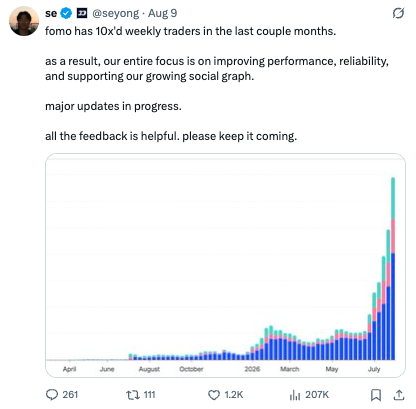
Then FOMO, the retail-friendly trading app, became the highest-revenue platform across all blockchains. Pumpfun, the original coin launchpad on Solana, posted its best week of revenue since March 2026.
The operating law behind all speculative economies is simple: Attention comes before capital flows.
Traders return before capital does, because returning costs them nothing but their time. Only later does the money that can significantly move prices follow.
I believe this is a positioning period across the industry.
Spot Bitcoin ETFs pulled in $626 million across the first three trading days of August. While the Fear and Greed Index still sat at 25, deep in extreme fear territory, institutions have began buying with size. At the same time, the “daily runner” has come back to the memecoin trenches, with the coin of the day reliably reaching $10 million to $20 million marketcap consistently.
Towards the end of the September, Robinhood’s 90-day gas subsidy and Lighter’s zero-free perps window both expire, giving the first honest read on whether Robinhood Chain’s activity can sustain.
2. Within Weakness There is Opportunity
The broader environment around crypto does not immediately signal strength, which is the very reason why I find the divergence in on-chain trading worth writing about.
A majority of large-cap altcoins are down 32-44%, and more than 100 crypto projects have shut down or gone dormant in the first half of 2026. Total value locked across DeFI fell 27% to a total capitalization of $71.8 billion.
Most of the damage traces back to October 10, 2025, when a tariff announcement triggered the largest liquidation event in crypto history. More than $19 billion in leveraged positions closed in 24 hours and the average token fell about 47%. Market makers, the firms that post the buy and sell orders that make a token tradeable, took losses and pulled their quotes. They have not rebuilt to their old size, which is why liquidity across smaller tokens is still thin.
And yet, the trenches are the busiest they have been in a year. Robinhood Chain, launched on June 30, surpassed Base in daily users within three weeks. Memecoin launchpads, both new and old, have begun processing millions of trades per day.
Both of these worlds, a weak top-down market and strong bottom-up activity, can exist in tandem and they are not contradictory.
Altcoin price action needs significant capital to move the needle, while onchain activity needs only trading volume. When trenchers start putting money back into the market, generating volume, and making profits, that capital gradually rotates into larger caps. More importantly, it rebuilds confidence across the entire ecosystem. As the casino starts to feel fun and easy at the furthest end of the risk curve, that renewed risk appetite can ripple upward, signaling a broader return to crypto and the early stages of relief from the bear market.
3. There is No Better Onboarding than Watching Someone Else Win
Onchain trading has become culturally acceptable again, and peer validation is one of the strongest inputs driving that return. People are making money, posting PnL screenshots, and flaunting the wins online. Trading celebrity is breaking out across Instagram and TikTok in much the same way day trading and forex influencers did a decade ago, except the lifestyle imagery is now funded by leveraged perpetual futures and onchain memecoins.
There is no faster or more efficient onboarding pipeline than watching someone else win. Seeing strangers turn small positions into six-, seven-, or even eight-figure outcomes lowers the psychological barrier to participation and creates the familiar cycle of imitation, risk-taking, and FOMO we see across speculative markets. As more people pile in, the visibility of those wins fuels its own distribution engine.
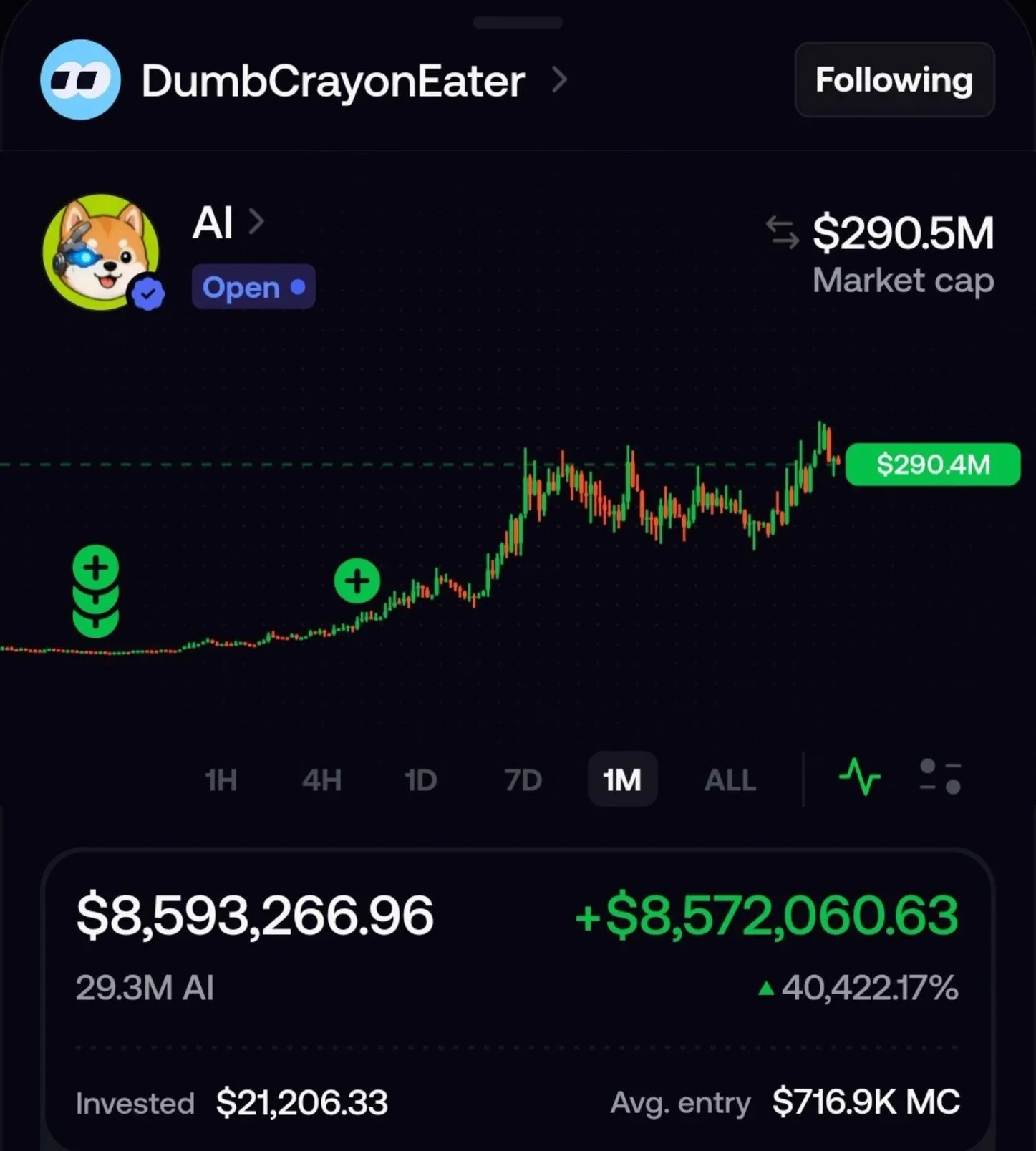
Targets are psychological infrastructure. When the best recent outcome anyone can name is $10 million, nobody sizes for $100 million and nobody holds for it either.
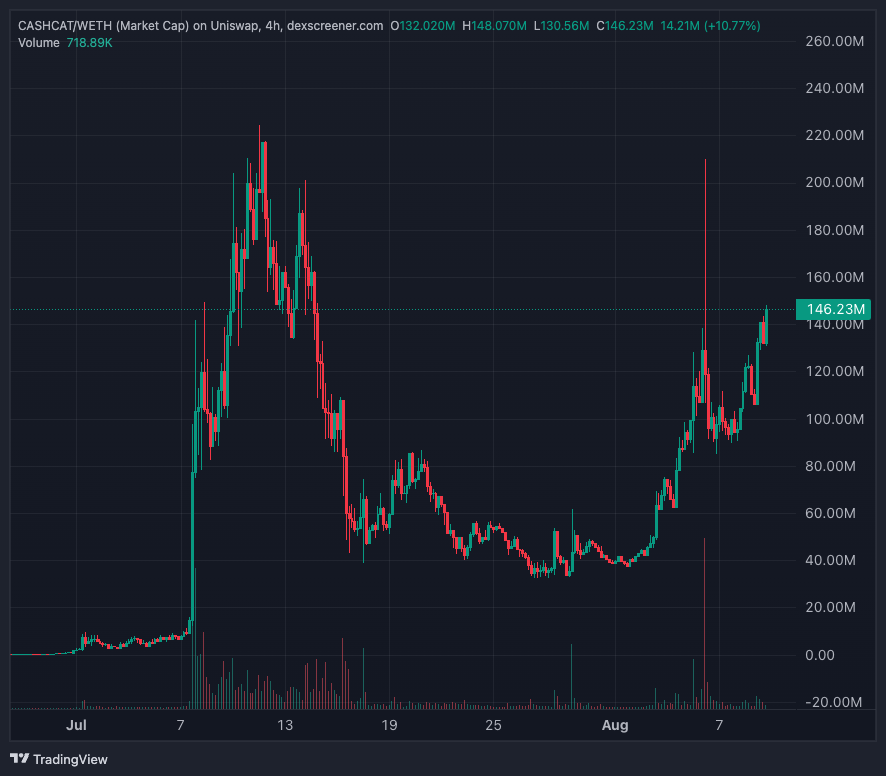
Deep in depths of a bear market, $CASHCAT was the coin that has completely reset everyone’s mental ceiling.
Before July, a good trench trade in this tape topped out at a few million dollars of market capitalization. After the initial engagement via a Twitter/X follow by Vlad Tenev, $CASHCAT ran to a peak above $224 million and gave the market a new number to anchor on.
Now we are seeing runners every day — coins are swiftly reaching $10 million to $20 million without effort, which did not exist for most of this year. When liquidity is normal, we may expect to see runners reaching $50 million to $100 million with ease.
4. Choosing Your Battle Arena
Specialization creates informational edge, and informational edge only exists where attention is sustained long enough to become pattern recognition.
Traders who were early to $CASHCAT and Robinhood Chain recognized an opportunity that was legible only if they had previous experience watching a new chain launch.
Robinhood Chain is a perfect case study in what traders call a “generational opportunity”: a massive consumer brand with tens of millions of funded accounts opened a permissionless network, paid everyone's gas fees, and had a mascot from day one with all the markings of an icon. This read would take years of pattern accumulation and only about ten minutes to fund a wallet and hit buy, which is the kind of trading discipline that is only achievable with experience.
In determining where and how to position for the potential on-chain bull run, I want to be clear that the ideal path is not to buy everything novel, or even obvious: The mechanics of individual assets or chains do not transfer between them.
Choose your crypto battle arena based on your access to information, risk tolerance, and portfolio size.
Differentiating between a daily runner or a blue chip meme, versus buying spot in an altcoin, or swing trading perps have entirely different strategies and approaches.
The honest trade-off is that specializing means you will watch things run in ecosystems you skipped, and that may make you feel like a you made a mistake every time. It is not. You are worse off fomo-ing in, arriving late to all of them, sizing as if you were early, and ultimately becoming exit liquidity to traders who know to maximize their edge.

5. Now We Wait For the Money
Early attention and speculative activity do not define the entire $2T crypto market, but they can offer some of the earliest signs that a broader bull market is beginning to form.
The next confirmation I am looking for is not another $200M+ memecoin, but whether onchain activity continues to grow once incentives disappear, whether liquidity begins rotating into larger assets, and whether institutional buying escalates as retail confidence rebuilds from the bottom up.
If Robinhood Chain collapses once the gas subsidy ends, broader macro conditions deflate risk appetite and Bitcoin, and new capital fails to enter the space, I would consider the past two months of euphoria a subsidized pocket of speculation inside a continuing bear market.
But if activity persists, runners become more frequent and larger in size, and the cultural appetite for speculation continues bleeding into non-crypto-native spaces, then we may have the trenches to thank for signaling the shift first.
The casino getting packed does not mean we are all getting rich yet. It means more players are sitting down at the table.